Wednesday, 16 February 2022

Top 3 dangers when using multimeter for 240v mains electrical work

⚠️ SAFETY MESSAGE: Electrical work is inherently dangerous. Using a multimeter on live 240V mains circuits carries a high risk of electric shock, arc flash, and fire if the tool is used incorrectly. Always ensure the power is off whenever possible and wear appropriate safety gear.

In the spirit of Philip Fisher, we want to manage our risks by understanding the "operational hazards" before we invest our time in a repair. Let's explore the three most critical dangers to keep you safe. I'll ask guiding questions along the way. 📈

The Dangers of High-Voltage Testing ⚠️

1. Incorrect Dial Setting 🔢

If the meter is set to Ohms/Continuity or Amps while testing Volts, it can create a short circuit and explode in your hand.

2. Poor Lead Quality 🔌

Damaged insulation or "shrouded" tips that are too long can cause an accidental short between terminals or to your fingers.

3. Incorrect CAT Rating 🏷️

Meters are rated for safety (CAT II, III, IV). Using a low-rated "hobby" meter on high-energy mains can lead to catastrophic failure.

Here are the three biggest safety issues when using a multimeter on electrical systems:

  • Wrong function selection: This gives an erroneous measurement. In the video below, I test a live electrical outlet in DC instead of AC and it shows a zero reading.
  • Unseated leads: I then show another zero reading with the meter leads not correctly seated.
  • Leaving the meter in Amps: If you try to measure voltage while in the Amps setting, the voltage will appear on one end of the meter leads.

Please watch the video below for a demonstration of this


The Dial Check 🔍

The most common mistake is having the meter dial set to the wrong function. If you just finished testing a thermostat for continuity (Ohms) and then immediately stick the probes into a live 240V socket without changing the dial, the meter will attempt to pass that high voltage through its internal circuit.

Guiding Question: If you are about to measure the power coming into a UK fridge, what specific symbol or letter should your multimeter dial be pointed toward to safely read that 240V Alternating Current? 📟

Tuesday, 12 October 2021

Top 5 common issues problems faults refrigeration fridge freezer

⚠️ SAFETY MESSAGE: Always disconnect the power supply before starting any appliance repair. Electrical components can cause severe shock or death if handled improperly. If you are unsure, consult a professional.

Top 5 Common Issues, Problems, and Faults with Fridge Freezers 🛠️

Identifying the "why" behind a breakdown is the first step toward a successful repair. Much like a "Fisher-style" investor looks for a company's competitive advantage, we look for the specific point of failure in a machine's cycle to understand how to fix it efficiently. 📈

Let's dive into the most frequent culprits that keep your fridge from performing at its best. I'll ask guiding questions along the way to help you master the diagnostic process.


The "Big Five" Faults 📋

FaultCommon SymptomPotential Root Cause
1. Thermostat Failure 🌡️Fridge is too warm or freezing food.Internal switch is stuck or sensor is faulty.
2. Compressor Issues ☢️Constant clicking or a dead fridge.Start relay is burnt out or compressor is seized.
3. Blocked Drain Hole 💧Water pooling at the bottom of the fridge.Food debris blocking the condensation channel.
4. Door Seal Leaks 🚪Heavy frost build-up or constant running.Gaskets are split, dirty, or losing magnetism.
5. Defrost Faults ❄️Freezer is iced up but fridge is warm.Defrost heater, timer, or sensor has failed.

Step 1: The "Silent" Diagnosis 🔍


In the video below i show the Top 5 common issues problems faults refrigeration fridge freezers i come across in my daily repairs.

These issues are 

Capacitor , these help start the motor in compressor if they are faulty the compressor will not start and usually hums, you nned to test this with multimeter, set multimeter to capacitance and measure if its 10% out of the capacitors stated range repalce it.

Relay and thermal cut out device are all built into one and are a regular problem of faulty fridges.

Compressors can fail both mechanically in which case usually you can hear the problem or electrically in which case you ned to test resistance of motor windings.

Regassing is a major iswsue i find eventually gas will leak from mirco crack in joints and eventually this will affect refrigeration cycle you need manifold gauges to test and regass.

Thermostat , these go often and need replacing if its already been replaced check it fits ok as most often people by cheap replacements and they are the incorrect length the phial then take incorrect readings and is virtually useless.


Gemini said


The easiest place to start is with the sounds (or lack thereof)

coming from the appliance. This is our "scuttlebutt" phase.

If the light inside the fridge comes on when you open the door,

but you don't hear the hum of the motor or the whirring of a fan,

we can narrow the problem down to the components that "command"

the cooling to start. Based on the table above, which component

do you think is primarily responsible for "deciding" when the

cooling system should turn on or off? 🧠

Wednesday, 29 September 2021

fridge freezer refrigeration capacitor testing and replacement

⚠️ SAFETY MESSAGE: Always disconnect the appliance from the mains power supply before attempting any inspection or repair. Capacitors store electrical energy and can deliver a sharp shock even when the unit is unplugged. If you are unsure, consult a qualified engineer.

Testing Fridge Freezer Refrigeration Capacitors 🧊

A refrigeration capacitor is a small but vital component usually found near the compressor. Its job is to provide the electrical "boost" needed to start the heavy motor (Start Capacitor) or to help it run more efficiently (Run Capacitor). If this component fails, your compressor may hum, click, or refuse to start entirely.

Let's explore how to diagnose this together. I’ll ask guiding questions along the way to help you through the process. 🛠️


Types of Fridge Capacitors ⚙️

TypeFunction
Start Capacitor 🚀Provides a high-torque "kick" to get the compressor motor spinning from a standstill.
Run Capacitor 🏃Stays in the circuit to improve motor efficiency and power factor while the fridge is cooling.


Easy test but can be slightly difficult to access wires , you need to remove the plastic wire covers and access the relay , find the capacitor wires and remove one as it might affect reading. use meter probes to contact the 2 caspacitor wires and test wth meter set to capacitance . The reading should be 5% + or - the rated capacitance. This one was a 2.5mF so 2.37mF lowest the reading i got is 2.32mF close to needing repalcement so i will replace it with a new one.


If the capacitor is faulty the compressor will be less efficient , it may start intermittently or not at all in which case all you will here is a hum and the fridge freezer unit will not get cold.


fridge freezer refrigeration capacitor testing and replacement

fridge freezer refrigeration capacitor testing and replacement


See video of this entire process below 


Testing fridge freezer refrigeration capacitor - YouTube


Visual and Physical Inspection 🔍

Before we use a multimeter, we should look for obvious signs of failure. In the spirit of "scuttlebutt" reporting, we can often see or hear a problem before we measure it.

If a capacitor has failed internally, the pressure inside can build up. When you look at the component, if you see that the top is bulging or if there is any oily fluid leaking from the terminals, the part is definitely faulty.

If the capacitor looks physically perfect but the compressor is making a repetitive clicking sound every few minutes, what do you think that sound suggests the compressor is trying (and failing) to do? 🕵️‍♂️


Friday, 13 August 2021

Fridge freezer refrigeration R600a gas system fault finding troubleshooting

When working on these system safety is the first priority. R600a is a flammable gas and precautions should be used when working on these systems, they do not hold much aprox 80 grams but still be careful when using and storing. Keep the room well ventilated when working on these systems and remember butane will settle to the bottom of a room being heavier that air.

If you suspect a problem with the system you can attach the gauge to take readings of the gases pressure to help with fault finding diagnostics. 


Fridge freezer refrigeration R600a gas system fault finding troubleshooting


Healthy systems can have a  static pressure reading of between 0.5 - 3 bar , that is with compressor off and pressure equalised from low to high.


With the gauge connected to low side and compressor turned on you would expect to see pressures between -0.1 and -0.6 , negative because your on low ( suction ) side of compressor.


If when you turn on compressor the gauge does not drop into the negative this is a sign your compressor is faulty.


If the system pulls into a complete vacuum it could be a sign of the system having a blockage somewhere if it goes below -0.6 slightly its worth adding a tiny squirt of gas but more than likely the drier unit has become blocked. ( replace drier unit , vacuum system and recharge.) 


Fridge freezer refrigeration R600a gas system fault finding troubleshooting


If you suspect a leak you can use an electronic sniffer to find R600a leaks quite easily, remember to turn compressor off for testing low side of the system and to turn compressor on for high side testing..


Thursday, 12 August 2021

Fridge freezer system recharging - re-gassing - top up R134A R600A Refrigerant gas

Vapour method ( upright bottle ) 

After you have vacuumed down the system and ensured its free of contaminants and moisture and leaks (  by allowing for enough vacuum time ) 

You gauges will still be attached to the low pressure line from vacuum down.

Attach the bottle of gas to the vacuum fill hose of the manifold gauge and ensure the gauges are zeroed 

open the bottle this will fill the hose , undo hose connection and purge the air form the hose so you do not put any air into the system.

You now need to open the tap to allow refrigerant into the low pressure side of the system, allow in a few grams of refrigerant and turn on the compressor. This will allow the compressor to draw in the refrigerant and circulate the vapour. Using your scales now add the exact amount needed to refill the system.

to finish shut of bottle valve and allow compressor to draw in refrigerant left inside the hose, once this is done turn off the valve to disconnect system from the manifold gauges. 

Low side pressure on a healthy system is usually between 0.1 and 0.6 bar.


Fridge freezer system recharging - regassing - top up


An excellent video refilling with liquid refilling upside down bottle.


fridge compressor change , Vulkan Lokring demonstration and recharging 
refrigerant.


Wednesday, 11 August 2021

Fridge freezer refrigerator vacuum testing refrigeration system Leak testing ( Negative Pressure ).

Vacuuming the system down is perhaps the most important step of the repair process.

Firstly the negative pressure you put the system under can be used to check for leaks and you clean out all the air , moisture etc from out of the system and being under negative pressure the moisture in the system will be boiled off as well .


Fridge freezer refrigerator vacuum testing refrigeration system Leak testing ( Negative Pressure ).


Make sure you ensure all pipe hoses and connection on your tools are tight nothing worse than chasing leaks to find its your equipment.

With the manifold gauge connected to the system via the inline Schrader valve tap on the low side, turn the pump on and open the valve connecting vacuum pump to circuit. you should here the note of pump change and sometime you will see mist come out of the pumps breathing port as moisture it burned off.


You should vacuum down for at least 20 minutes to burn off moisture you should then shut the vacuum pump off and allow the system to hold its negative pressure for another 20 minutes.

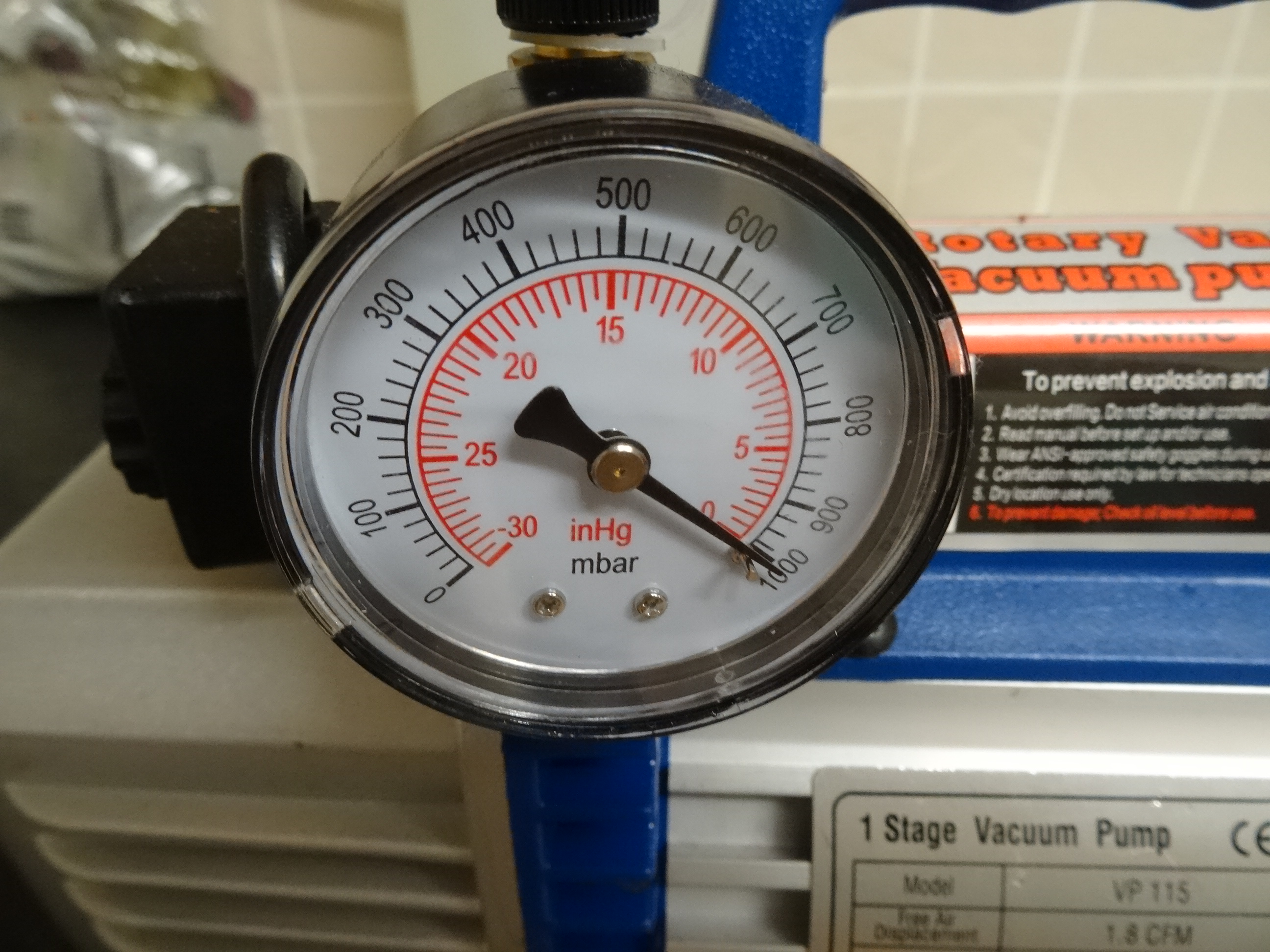
The main gauge will be at minus 30 psi but it can be hard to spot leaks on this so it best to use a more powerful gauge, the vacuum pump I own has a very sensitive gauge and it will easy show up even the most minor of leaks so a always not and watch the reading of both.


Fridge freezer refrigerator vacuum testing refrigeration system Leak testing ( Negative Pressure ).


If it holds for 20 minutes your fine to regas if not you need to find the leak. 


Fridge freezer refrigeration manifold gauges re-gassing topping up recharge

I use the single gauge manifold as below its been excellent for my uses I use it for system testing refill through it and vacuum down.

Fridge freezer refrigeration manifold gauges re-gassing topping up recharge


The gauge is used to measure the pressure in the system ( low side ) suction, in PSI or bar if you have the correct gauge for the gas being used the temperature scale can be used to find the evaporator temperatures at certain pressure to aid in diagnostics. But this gauge it mainly used by me for checking gas pressures and good operation of the compressor.

Fridge freezer refrigeration manifold gauges re-gassing topping up recharge


When putting the system under a vacuum i use the gauge on my vacuum pump this reads in milibar and is much more sensitive to pressure changes and even very minor leaks can be found. Well worth checking as ive gone to customers houses after other techs and found minor leaks that shut the fridge freezer down again weeks or a couple of months after.

Fridge freezer refrigeration manifold gauges re-gassing topping up recharge


The gauges when connected give a reading instantly the on off tap only opens the valve to the centre valve for topping up or vacuuming down purposes. 

See photo below to help visualise this , the gauges will always read pressure measurement. 

Fridge freezer refrigeration manifold gauges re-gassing topping up recharge